Laila Shahzada | In Remembrance of Laila | 1926 - 1994
The tragic accident that has robbed us of one of the most loved artists in Pakistan, has brought irrevocable changes to the existing art structure in the city. Cultured and soft-spoken, Laila Shahzada was to fellow artists, a rare symbol of integrity, generosity and dignity.
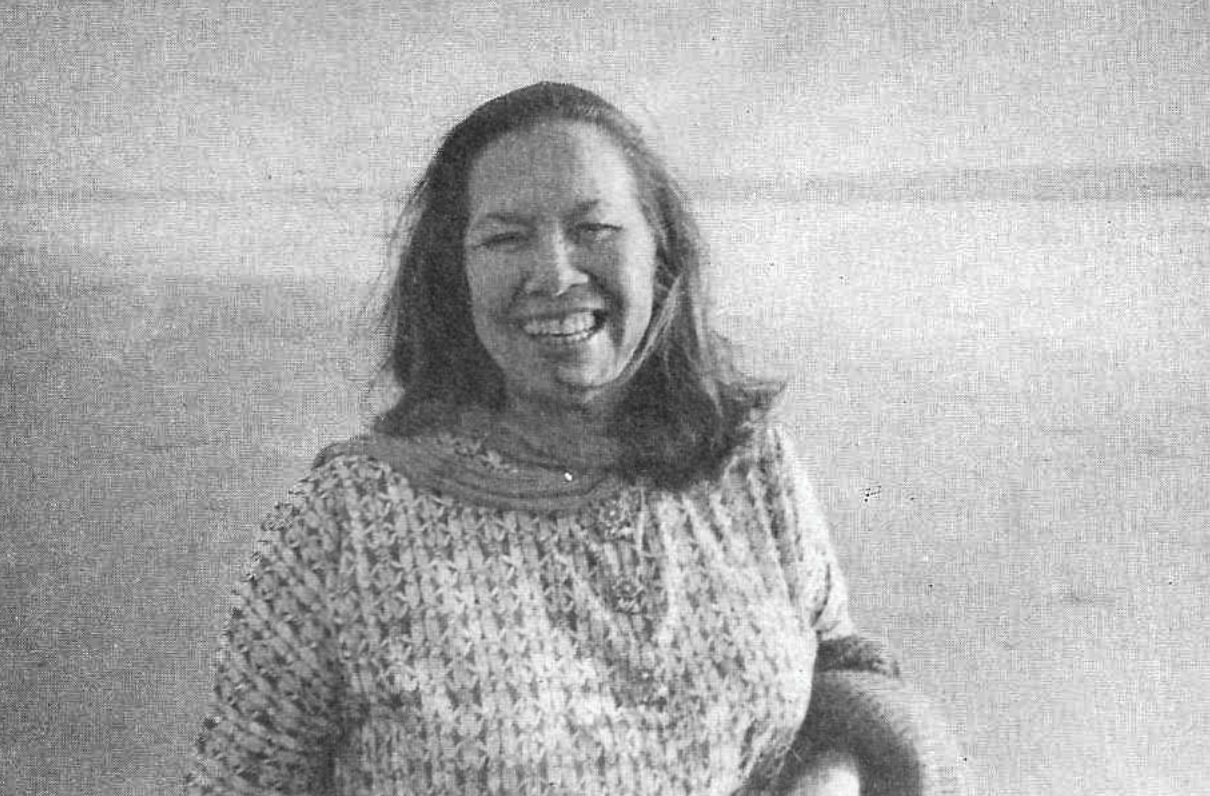
Laila Shahzada Searching for Driftwood
Painting was the passion that sustained her psyche, a way of harnessing her emotional unrest. Instead of words, Laila articulated her innermost thoughts with sweeping strokes, curved lines and a classic approach to oils that became an integral part of many moods and phases. The image of one particular painting remains fixed in my mind. Full of pain, it is a portrait of agony. Mouth opened to emit a silent scream, one eye jutting and full of blood, it is riveting. The artist titled it 'Self Portrait.'
Without being part of a movement or consciously aware, Laila was one of the few, true feminists in art in the country. A development that began in the early '60s, feminism established a 'Sisterhood', a mutual support system, in which women banded together to help and encourage each other without competitive barriers. Laila instinctively understood this. She was unfailingly 'there' for her friends, most of them of many years standing.
Completely non-judgmental, her utter simplicity and lack of artifice was disarming. Laila rejoiced in the triumphs of her fellow artists and sympathised with them in their disappointments. She had the ability to make her friends feel 'special' - important to her, and each one was. Nagi, who encouraged her to paint in his studio many years ago, Ali Imam, Ahmed Parvez, Gulgee, Ajmal Hussain and Sadequain, all were close friends from the early days of art beginnings in Karachi. A woman of timeless quality, she was keenly interested in young painters too and proud of the talented women artists who emerged on the scene with panache.
Laila was thrilled with children's art displays and was often sought out to be the 'Chief Guest' at art events in local schools. She loved folk arts and crafts and delighted in talking to the craftsmen and women of the rural areas. Some years ago, she was instrumental in exhibiting a display of Truck Art', paintings from the colourful trucks that travel the length and breadth of Pakistan. It was the first exhibition of its kind in the country.
A devoted mother, whether her children were here or abroad, they were constantly in her thoughts and she eagerly looked for hints of artistic talent in her grandchildren. Busy, revered by a wide and varied circle of friends, yet there was always an element of mystery about her, a quality of inherent solitude which was solaced only by painting. She appeared to be happiest and most at peace while immersed in the hands-on experience of covering canvas surfaces with oils. Often splashing the paint onto the walls and herself with absorbed oblivion, there she entered a world of her own.
The first major exhibition of Laila's work was held in 1964 at the Karachi Arts Council, where she displayed the Drift Mood series. Inspired by pieces of driftwood thrown up by the sea, the artist covered canvases with sinuous shapes, embodying them with an emotional vibrancy that created waves in Pakistan's art circles of the '60s.
The enigma of the Indus Valley Civilisation captured Laila's imagination when she designed costumes for a film on Moenjodaro by A.J. Kardar, and later for a similar theme created by the Pakistan National Dance Academy. She developed a major series of paintings titled Moenjodaro, the first artist in Pakistan to draw inspiration from the early Civilisation. In the series, she merged her own intrinsic strain of mysticism with fragments of history and mythology. These paintings were first displayed in Karachi in '71 sponsored by the Pakistan Tourism Corporation.
In the '80s, Laila held a series of exhibitions abroad, in America, England and France. In New York she was awarded the Bicentennial gold medallion, and the key to the city of New York. In 1986, she was honoured in Pakistan with the Tamgha-e-Imtiaz.
The artist's last series, one she exhibited at the Chawkandi Gallery in December, and which was recently displayed at the Pasadena Museum, California, was conceived when turbulent climatic conditions, kept her a willing prisoner in the mountainous regions of the north. Experiencing the awesome splendour of nature's design, she began to envisage the mountains as an analogy for the country itself, seeing sleeping giants, and dormant, unharnessed power in the shadows and shapes of the rocks.
Enjoying the company of committed artists, Laila made several friends among the foreign artists she met abroad. An exhibition of artists held at the Westminster Gallery in 1989, she was the only artist from the East to participate and radiated delight at the interest in her work and background shown by the group. The artist was often perplexed. In the west she enjoyed the aesthetic freedom, openness and opportunities, yet she always returned to Pakistan. It was home.
For some time, Laila had enjoyed experimenting with texture and collage in her work, using cork boards to create a relief effect. She began this work while in London, seeing the roof-tops and reflections of wet streets from her window as many layered images, ones she returned to frequently. These paintings, never yet displayed, were to be exhibited at the Indus Gallery at the end of the year.
An artist of international repute, Laila did not paint to please an art market, she painted from her own conviction, yet many discerning collectors, from the east and west, acquired her work.
Laila always dreamed of a Museum of National Art for Karachi. In her personal collection, there is a valuable painting which she had earmarked for the museum, hopeful that there would be one some day. Painted in the '70s, it is a unique blending of the two periods , 'Drift Mood' and 'Moenjodaro' in which she eulogises the serene Gandhara sculpture of the great teacher. Like many of the founders of Pakistan's art development, artists now passed into the annals of art history, Laila will not see her dreams realised.
MEMORIUM
By Marjorie Husain
DAWN Tuesday Review, Aug 2 - 8, 1994